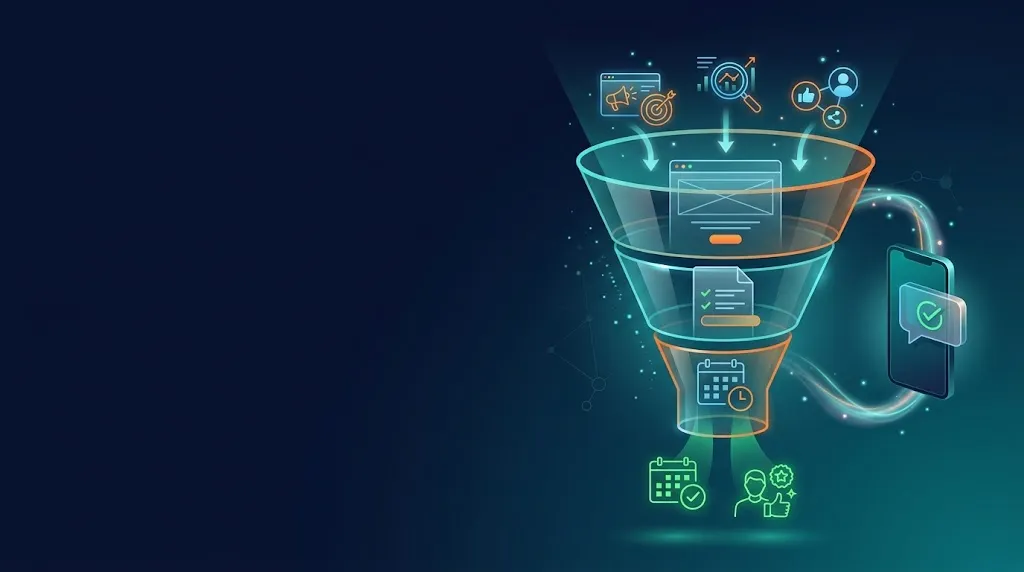
High Converting Funnel GHL: How to Build One That Sells
Picture a local dentist who spends $1,500 on Facebook ads. The ads get 400 clicks. Only 3 people fill out the form, and one of them never answers the phone.
The ads weren’t the problem. The funnel was. If you want a high-converting funnel in GHL, the work starts after the click: a clear page, a short form, and a follow-up that arrives in minutes, not days.
This guide walks you through building that inside GoHighLevel, step by step, in plain language.
What makes a funnel “high converting” in GoHighLevel?
A high-converting funnel does one thing well. It moves a stranger to a single next step, like booking a call, without confusing them along the way.
There’s no magic conversion rate that counts as “good.” It depends on your industry, your offer, and where the traffic comes from. A cold Facebook audience converts differently from someone who searched “emergency plumber near me.” Track your own baseline first, then improve it. [Add your benchmark here if you have one.]
What high-converting funnels share:
One clear offer per funnel
One main call-to-action (CTA) per page
Fast load time, especially on phones
Instant follow-up after someone opts in
Why build your sales funnel in GHL instead of separate tools?
Most small businesses stitch things together. A page builder here, an email tool there, a calendar app somewhere else, and Zapier gluing it all together. It works until one piece breaks and quietly disappears.
The GoHighLevel funnel builder keeps the page, form, CRM pipeline, calendar, and automation in one place. When someone submits a form, the contact enters your pipeline, a text is sent, and your team is notified. You don’t have to wire up five logins to make that happen.
That’s the real advantage of a GHL sales funnel. It’s less about the page itself and more about what happens behind it.
What pages does a GHL funnel actually need?
Not every funnel needs ten pages. Most service businesses do fine with this simple flow.
Opt-in page. The first page people see. It has a headline, a short benefit statement, and a lead capture form.
Booking page. If you sell high-ticket services, send people straight to a calendar after they opt in. This is your appointment funnel.
Thank you page. Many people skip this one, which is a mistake. It confirms the next step and can carry a short video or a reminder to check their phone.
Upsell and downsell pages. These are optional, and they make more sense for products or low-ticket offers than for consultations.
Start small. You can always add pages once the basic funnel is bringing in leads.
How do you design a landing page that converts?
A good GoHighLevel landing page design isn’t about fancy graphics. It’s about removing reasons to leave.
Here’s what to focus on:
Headline: Say what the visitor gets and how fast. “Get a free roof inspection quote in 24 hours” beats “Welcome to Smith Roofing.”
One CTA: Repeat the same button text throughout the page. Don’t give people three different actions.
Proof near the top: A short testimonial, a star rating, or a “Certified Partner” badge builds trust before they scroll.
Mobile first: Most of your visitors will arrive on a phone. Open your page on your own before you publish it.
No navigation menu: A full site menu invites people to wander off. Keep the funnel page focused.
If you’re short on time, GHL funnel templates are a decent starting point. Just edit the copy so it sounds like your business, not a generic template.
How many fields should your lead capture form have?
Fewer than you think. Name, phone number, and email are enough for most offers. Every extra field costs you some completions.
If you need more detail to qualify leads, add a single question with a dropdown, such as “What service do you need?” It’s easy to answer and gives you useful context for follow-up.
One more thing for US businesses. If you plan to text leads, add a clear consent checkbox. You’ll need it for compliance, and it ties directly into A2P registration, which I’ll cover below.
How do you automate follow-up in a GHL funnel?
This is where most funnels win or lose. Research on lead response time keeps pointing in the same direction: the faster you reply, the better your chances. [Add a cited stat here if you want one.]
A solid GHL workflow automation setup for a new lead looks like this:
Lead submits the form.
They get an instant text and email confirming the next step.
The contact moves to the next stage in your CRM pipeline.
If they don’t book within a few hours, a reminder goes out.
If they still don’t respond, a short email and SMS sequence runs over the next several days.
If the lead calls and no one picks up, a missed-call text-back fires automatically.
That last one is underrated. A missed-call text like “Sorry we missed you, how can we help?” recovers many leads who would otherwise call your competitor next.
If you’re sending texts to US numbers, you need A2P 10DLC registration approved first. Without it, your messages can get filtered or blocked. If that part feels confusing, our A2P registration service handles it for you.
A quick example of a funnel in action
Imagine a home cleaning company running Google ads to an opt-in page offering a free quote. Before the funnel, leads filled out a basic contact form, and the owner called them back whenever she had time. Some waited a full day.
After rebuilding it in GHL, each lead gets a text within a minute asking for their address and preferred time. They can book an estimate right from the text. If they don’t, a reminder goes out the next morning.
[Insert your real before-and-after numbers here, like booking rate or response time.]
The offer didn’t change, and neither did the ad budget. The speed and clarity of the follow-up did.
What should you test first for funnel conversion rate optimization?
Don’t change everything at once. You won’t know what worked.
Test in this order:
Headline. It has the biggest effect on whether people stay.
CTA button text. “Get My Free Quote” often beats “Submit.”
Form length. Try removing one field.
Offer. A free audit, a discount, or a quick consultation can perform very differently.
Follow-up timing. Try sending the first text sooner, or adding a second reminder.
Give each test enough traffic to mean something, and change one thing at a time.
What mistakes kill funnel performance?
I see the same few problems again and again:
Sending ad traffic to a homepage instead of a dedicated funnel page
Asking for too much information up front
Forgetting the thank you page
Slow or no follow-up
Skipping A2P registration and wondering why texts aren’t delivering
Never check the funnel on mobile.
Fix these before you spend more on ads.
When should you hire a GHL funnel expert?
If you’ve got the time, building your first funnel yourself is a good way to learn the platform. But if you’re busy running the business, a done-for-you GHL funnel can save weeks of trial and error.
Look for someone who builds the funnel and the automation behind it, not just the pages. Ask to see testimonials or examples. Ask how they handle A2P registration, pipelines, and follow-up sequences. A real GHL-certified partner will have clear answers.
FAQs
1. What is a high-converting funnel in GHL?
It’s a funnel built inside GoHighLevel that guides visitors to one clear action, like booking a call or requesting a quote, and follows up automatically. The page, form, CRM, and automation work together in a single system.
2. How much does it cost to build a funnel in GoHighLevel?
The funnel builder is included with your GHL subscription, so you’re mostly paying for your time or a specialist’s time. Pricing for done-for-you work varies by scope. [Add your pricing or starting range.]
3. Can I use GHL funnel templates?
Yes, and they’re a good way to start. Just rewrite the headline, copy, and images so the page matches your offer and brand. Unedited templates tend to look generic.
4. How long does it take to set up a GHL sales funnel?
A simple opt-in, booking, and thank you flow can be built in a day or two. Adding workflows, email, and SMS sequences, and testing usually takes a bit longer.
5. What’s the difference between a funnel and a website?
A website gives people many places to go. A funnel gives them one. That focus is why funnels usually convert better for a specific offer.
6. Do I need A2P registration to text leads from my funnel?
If you’re texting US numbers, yes. A2P 10DLC registration is required by carriers, and unregistered messages can be blocked or filtered.
7. What’s a good conversion rate for a lead generation funnel?
It depends on your industry, traffic source, and offer. Instead of chasing a universal number, measure your current rate and aim to beat it over time.
8. How do I improve my funnel conversion rate?
Start with the headline, CTA, and form length, then speed up your follow-up. Change one thing at a time so you can see what made the difference.
9. Can GHL automate follow-up for missed calls?
Yes. You can set up a missed call text-back so anyone who calls and doesn’t reach you gets an instant text from your business number.
10. Should I hire a GHL funnel expert or do it myself?
If you enjoy tinkering and have time, start with yourself. If you’d rather focus on clients, hiring an expert gets you a working funnel faster and helps you avoid common setup mistakes.
Ready to turn your traffic into booked calls?
A funnel that converts doesn’t have to be complicated. It needs a clear offer, a simple page, and a fast follow-up. If you’d like help building one, reach out to a GoHighLevel Certified Partner and map out your funnel together.


